
Petru Lucaci
Sortir du noir
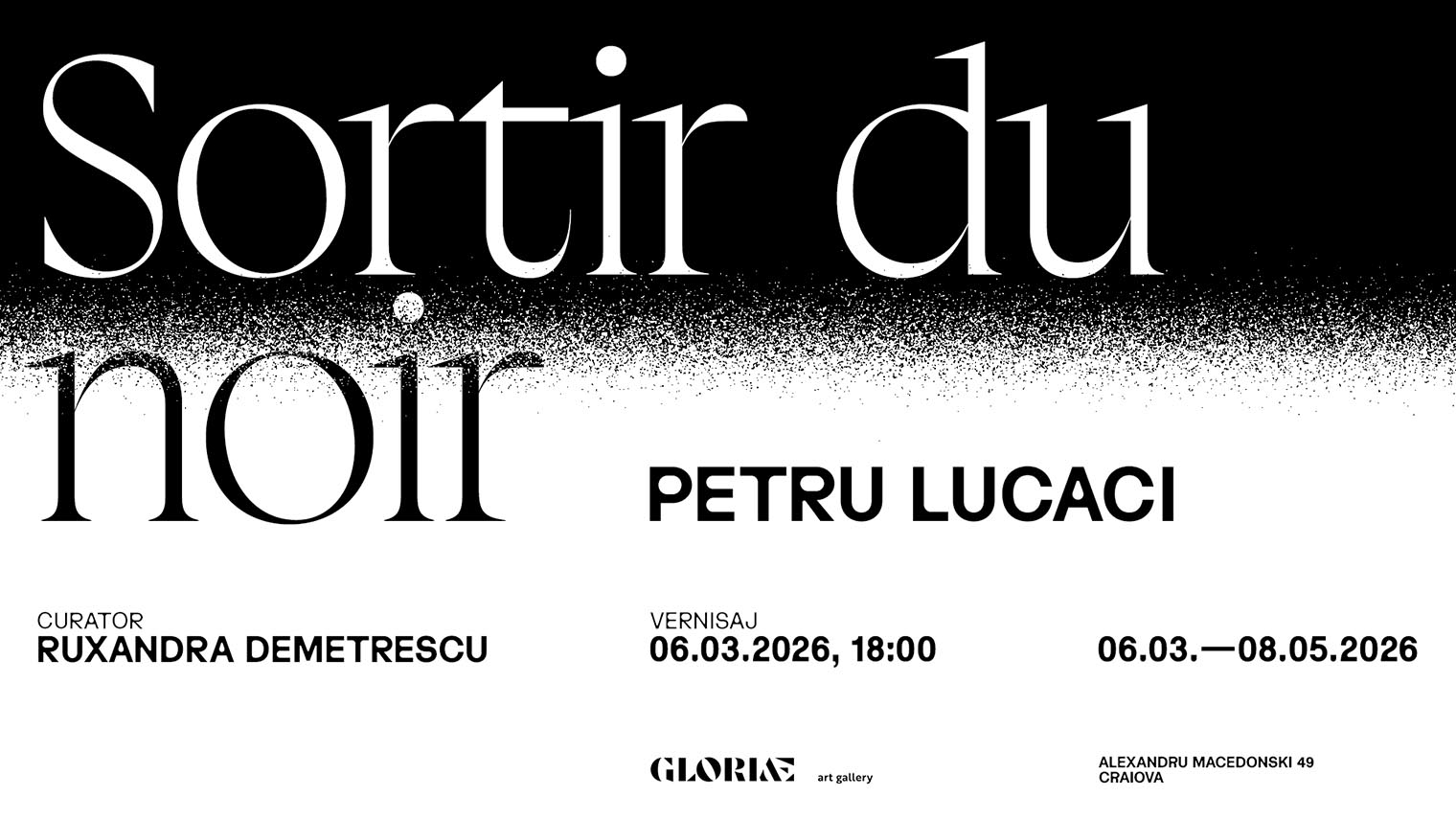
EXHIBITION 06/03/2026 - 16/01/2026
Petru Lucaci - Sortir du noir
Curator: Ruxandra Demetrescu
The title, Sortir du noir, is an explicit reference to the book of the same name by French theorist Georges Didi-Huberman and highlights the formal and conceptual concerns of the visual artist in two distinct projects: chiaroscuro and the human body. The current curatorial approach is marked by reconsideration and synthesis: reconsideration, because Petru Lucaci revisits the essential theme of a journey that began more than three decades ago, in which black was the dominant color, visible in several cycles (Nightshades, Black/White, Night Shadows, Chiaroscuro, Black-based Cocktail)
About the artist
Constantly preoccupied with the possibilities and limitations of painting, Petru Lucaci has always taken a radical approach toward the traditional "elements of painting": drawing, chiaroscuro, color, spatial configuration, and, last but not least, the history within the painting. The reconversion of chiaroscuro into painting reduced to black was probably the artist's most interesting visual experience, as it abolishes chromatism while preserving the contrast between light and dark.The present exhibition presents, retrospectively, in the first room of the gallery, three large polyptychs from the Chiaroscuro cycle, created in 2012.
The return, in recent years, to the title "Chiaroscuro" is symptomatic, as it signifies, in his latest pictorial experiments, a 'break' from the absolute black previously practiced as the only chromatic possibility and an emphasis on spatial depth. We are now witnessing a dialogue between the power of black and the expressiveness of color, which infiltrates, at first sparingly, and then bursts into the texture of his paintings. To quote the artist: "Translated into everyday space, the technique of chiaroscuro—the suggestive contrast of light, shadows, and darkness—takes a back seat, its potential for meaning being of utmost relevance. Chiaroscuro becomes a means of artistic (re)definition of an uncertain, undecided world, always in search of something and someone, a world of those on the margins, on the periphery, of those in search of 'light' or fleeing from 'light'". In my own scenario, this statement resonates with a phrase from Sortir du noir: "Une image qui sort du noir, c'est une image qui surgit de l'ombre ou de l'indistinction et qui vient à notre rencontre." The aforementioned reconsideration is transformed into a surprising synthesis through the integration of another distinct moment in Lucaci's artistic activity, focused on the human body, materialized in several cycles and significant for the ambition to realize an artistic research project. In Petru Lucaci's case, the body speaks its own language, in an artistic practice dominated by the cult of the fragment and the technique of montage, which allows assemblage/permutation of fragments into multiple compositions that can endlessly change their visual configuration and meaning. Thus, the works exhibited in the pavilion (in the large installation Sortir du noir, which brings together, chronologically and thematically, the cycles Dressing the Body and Disembodying the Body) highlight the treatment of the body through a process of fragmentation. From Dressing the Body (2015) to Disembodying the Body (2023), there has been a conceptual radicalization in the treatment of the female body through decapitation (the absence of the head is striking at first glance) and the arbitrary combination of the upper and lower parts of the body. The result is paradoxical: the body is dehumanized, transformed into a mannequin, which becomes a support for precarious, often frayed clothes. The mixed techniques, accompanying the venerable one of oil on canvas, produce a profoundly ambiguous effect: the forms disintegrate, lose their contours, and merge with the background of the painting. From the perspective of the viewpoints, one could say that Petru Lucaci combines close-up vision, cultivating haptic materiality, with an illusory distant view.
In a text published in 2016, Lucaci confessed that "our attitude towards our bodies is dual and ambiguous: we are passive/receptive to society's demands on what we should do, or, on the contrary, we have a reflexive, critical attitude, we actively intervene on our bodies, affirming or denying with full knowledge, assumed, social and cultural conventions and norms," recalling "the body as a support, reconstructed from images projected onto the body, a support for an exercise in visual language.”
The intrusion of the body (always female) into an abstract formal universe marks the moment of synthesis, paradoxically emphasizing a deeply contradictory visual mise-en-scène: the viewer may be distressed by the masculine manipulation of the female body, assaulted by fragmentation and decomposition or, on the contrary, may be encouraged to reflect more generally/generously on the vulnerability of the human being due to the excesses of contemporary society. Both attitudes share the risks of alienation caused by the transformation of the body into an object, now and here (only) exposed to our gaze. For, as Michel Journiac, the founder of body art in France, states, the body becomes the privileged place of traces, imprints, and wounds, adding that, ultimately, "c'est le corps qui parle" (it is the body that speaks).
Lucaci, however, offers us a surprise, materialized in his latest cycle, Connecting the Body - presented in two rooms of the gallery - in which the human (female) body represents an alternative to the excessive fragmentation seen previously by reconnecting with the environment - from samples of nature (the artist seems to favor monumentally large flowers) to suggestive corners of his studio. Thus, the human body is brought back to life, gaining a new vitality, as if illustrating Nicolas Bouvier's phrase: "Le corps est, pour le meilleur et pour le pire, l'image du monde" (The body is, for better or worse, the image of the world).
The next step, "emerging from the surface," is accomplished in the three-dimensional experiment, visible both in the series of objects and reliefs made of black-painted wood (exhibited in the pavilion) and in the most recent works in the exhibition: the reliefs - brought together in the cycle Sorties de la surface - made of fibreglass, resin, covered with acrylic spray paints (exhibited in the arcade room of the gallery).
Looking at the visual show proposed by Petru Lucaci in this exhibition, which marks an emblematic turning point in his artistic activity, I remembered another phrase from Sortir du noir: "L'image qui sort du noir se caraterise par ses propres limites tactiles." The problem of the limit between the visual and the tactile, between the black and the chromatic exuberance - which "comes out of the black" - also has a profound spiritual significance for Petru Lucaci, which must be deciphered with the attentive and patient gaze of the viewer. For, as Georges Did-Huberman states: "Une image qui sort du noir vient donc à notre rencontre. Elle surgit afin que que ce que nous y voyons puisse nous regarder vraiment et, donc, nous toucher de quelque façon."
I suggest the attentive visitor to linger over the last sequence in the exhibition, Sortir du noir II; the five small diptychs, which I have placed discreetly and somewhat imprudently in the corridor leading to the exit, are intended to strike the viewer with their formal and chromatic exuberance.
By combining older fragments from Dressing the Body with Lucaci's experiments from recent months, I hope that this new combination will activate the viewer's sensitivity, allowing him or her to look at an image designed to provoke thoughtful reflection.
Ruxandra Demetrescu
Petru Lucaci (b. 1956) is a visual artist, a university professor (Ph.D.) at the National University of Arts in Bucharest, a curator, and a central figure in Romanian cultural management, holding the positions of President of the Romanian Fine Arts Union and Director of Arta Magazine since 2010. He graduated from the Painting Department of the "Nicolae Grigorescu" Institute of Fine Arts in Bucharest in 1982. He holds a Ph.D. in Visual Arts, having defended his thesis "On Black" (Despre Negru) in 2006. His exhibition record includes participation in over 250 group exhibitions domestically and internationally, as well as over 45 solo exhibitions. His artistic practice encompasses painting, graphics, photography, object/installation, happening, and new media. In 2004, he was awarded the Order of Cultural Merit in the rank of Officer, Category C, and in 2006, the Romanian Fine Arts Union awarded him the Excellence Prize